Reading the Room Across a Million Messages: What Your Communication Data Says About Organizational Intelligence
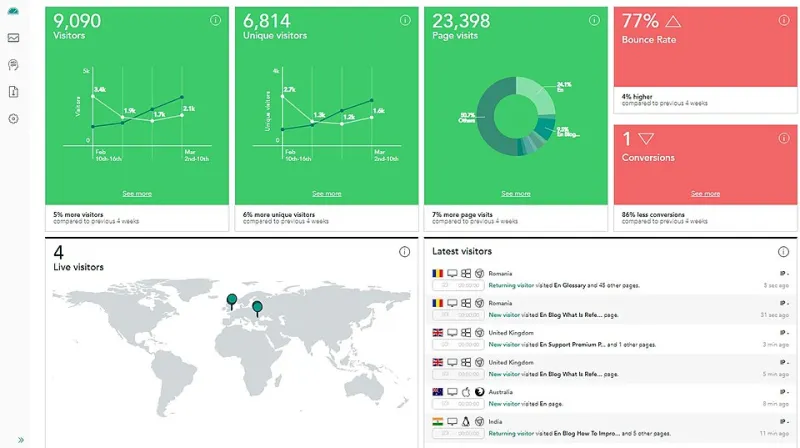
Photo: Visitor analytics, CC BY-SA 4.0, via Wikimedia Commons
Every organization running Slack, Microsoft Teams, or a comparable communication platform is sitting on an extraordinary archive. Millions of messages. Years of conversational history. The complete, timestamped record of how information has moved through the organization, who has spoken to whom, and—critically—what kinds of questions people have been willing to ask out loud.
Most organizations treat this archive as infrastructure: something to be searched when a specific message needs to be retrieved, audited when a compliance issue arises, or migrated when a platform changes. Almost none treat it as what it actually is—a diagnostic instrument capable of measuring something that conventional metrics consistently fail to capture: the intellectual health of the organization itself.
That gap represents both a missed opportunity and a growing risk.
Why Communication Patterns Reveal What Surveys Cannot
Organizations that want to understand their own culture typically reach for surveys. Employee engagement scores. Pulse checks. Net promoter metrics. These instruments have genuine value, but they share a structural limitation: they measure what people are willing to say when they know they're being measured.
Communication data operates differently. It captures behavior as it happens, in the context of actual work, without the self-consciousness that survey instruments inevitably introduce. The patterns embedded in that data—who asks questions of whom, how often exploratory conversations occur, whether technical debates cross team boundaries—reflect organizational reality more faithfully than any self-reported measure.
This is not a novel insight. Organizational network analysis has been a recognized discipline for decades. What has changed is the scale and accessibility of the underlying data. A decade ago, mapping communication patterns required expensive sociometric studies and significant research infrastructure. Today, every Slack workspace contains more behavioral data than most organizational researchers have ever had access to—and much of it is analyzable with tools that require no specialized expertise.
The Signals Worth Tracking
Not all communication patterns are equally diagnostic. Through examining organizations that have conducted this kind of analysis, several indicators emerge as particularly reliable proxies for intellectual health.
Question frequency and distribution. The simplest starting point is also one of the most revealing: how often do people ask questions, and where do those questions go? Organizations with healthy inquiry cultures show question traffic that flows across team and functional boundaries—people asking colleagues in other departments for perspective, context, or expertise. Organizations where question-asking is concentrated within existing team clusters, or where question frequency has declined over a measurable period, are exhibiting early warning signs of intellectual narrowing.
The ratio of declarative to exploratory communication. Healthy organizations maintain a balance between messages that assert conclusions and messages that open inquiry. When the ratio shifts heavily toward declarative communication—when the dominant conversational mode becomes "here is the answer" rather than "here is the question"—it often signals a culture where certainty has become more socially rewarded than curiosity. This shift is rarely visible to the people inside it. It becomes clear almost immediately in the data.
The persistence of unresolved threads. In intellectually active organizations, some conversations don't resolve cleanly. They generate more questions than answers, attract contributors from unexpected quarters, and continue over days or weeks without arriving at a definitive conclusion. These threads are the conversational equivalent of basic research—they don't produce immediate outputs, but they build the conceptual infrastructure from which eventual breakthroughs emerge. When this category of conversation disappears from an organization's communication record, it typically means that exploratory thinking has been crowded out by execution pressure.
Cross-functional bridge activity. Every organization has what network analysts call "bridges"—individuals whose communication patterns connect otherwise separate clusters. These people are disproportionately valuable as carriers of unexpected ideas across domain boundaries. Tracking whether bridge activity is increasing or declining, and whether bridge roles are occupied by a diverse range of people or concentrated in a small number of connectors, provides a sensitive early indicator of whether the organization's intellectual diversity is being maintained.
A Practical Audit Methodology
Conducting this kind of analysis doesn't require a data science team or a six-figure consulting engagement. A structured approach that most organizations can execute with existing resources involves three phases.
Phase one: Baseline mapping. Export message metadata—sender, recipient or channel, timestamp, and message length—for a representative period, typically the prior twelve months. Most enterprise communication platforms provide this data in accessible formats. The goal at this stage is not content analysis but structural analysis: mapping the network of who communicates with whom, and at what frequency.
Phase two: Pattern identification. Using the baseline map, identify the key indicators described above. Question frequency can be approximated by searching for messages ending in question marks, though more sophisticated approaches using natural language processing will yield richer results. Cross-functional activity can be mapped by tagging each communicator with their team or department and analyzing how much traffic crosses those boundaries. Trend analysis—comparing current patterns to patterns from twelve or twenty-four months prior—will surface changes that point-in-time snapshots miss entirely.
Phase three: Qualitative interpretation. The data will identify patterns; it will not explain them. Declining cross-functional question frequency might reflect organizational silos, but it might also reflect a recent reorganization that legitimately consolidated related functions. The quantitative findings should be treated as hypotheses to be investigated through targeted qualitative conversation, not as conclusions in themselves. The value of the data is that it tells you precisely where to look—not what you'll find when you get there.
What the Findings Typically Reveal
Organizations that have undertaken this kind of audit tend to encounter a consistent set of findings, though the specifics vary considerably.
In one mid-sized software company that conducted an informal version of this analysis after noticing a decline in cross-team collaboration, the data revealed that question-asking across team boundaries had dropped by roughly forty percent over eighteen months—a period that corresponded with the introduction of a new performance management framework that evaluated teams primarily on individual OKR completion. The framework had inadvertently created incentives for teams to solve problems internally rather than reaching outward, and the communication data captured the behavioral consequence with precision the performance metrics never would have surfaced.
In a separate case involving a professional services firm, the analysis identified a small number of individuals whose bridge activity had been dramatically curtailed following a reorganization. These individuals had previously served as connectors between the firm's technical and client-facing functions—precisely the cross-domain role most likely to generate the unexpected combinations of insight that differentiate advisory work. Their reduced connectivity was invisible in the org chart. It was unmistakable in the data.
The Ethical Dimension
Any discussion of communication surveillance in organizational contexts must acknowledge the legitimate concerns it raises. Employees have reasonable expectations about how their workplace communications are used, and organizations that conduct this kind of analysis without transparency risk eroding exactly the psychological safety that intellectual health requires.
The appropriate response to this tension is not to avoid the analysis but to conduct it transparently and with clearly defined constraints. Aggregate pattern analysis—which examines the structure of communication flows rather than the content of individual messages—can yield most of the diagnostic value with a fraction of the privacy intrusion. Organizations should communicate clearly what data is being analyzed, for what purpose, and with what safeguards. The goal is to understand the organization's intellectual culture, not to surveil individual employees.
Done responsibly, this kind of analysis is among the most powerful diagnostic instruments available to leaders who are serious about building organizations capable of sustained intellectual vitality. The data is already there. The question is whether anyone is curious enough to read it.